


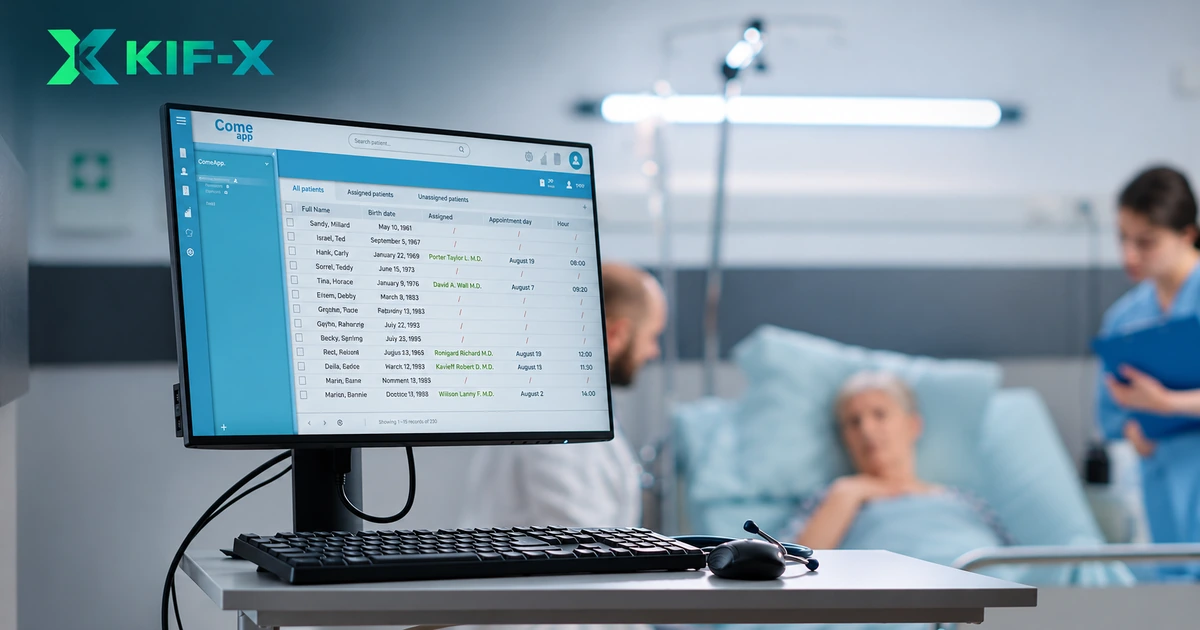
Hospital accounting software helps hospitals and clinics manage financial transactions, monitor expenses, track revenue, reconcile accounts and prepare financial reports. For healthcare providers in the UAE, choosing the right system also means understanding how finance data connects with clinical activity, operational costs, reporting requirements and data protection.
KIF-X MedCosting supports the clinical costing side of healthcare financial management. It helps hospitals and clinics organise cost centres, allocate overheads, analyse service and encounter costs, and review costing results. These capabilities are particularly relevant to healthcare organisations that want a clearer picture of the actual cost of delivering patient care.
What Is Hospital Accounting Software?
Hospital accounting software is a financial management solution designed to support the accounting and reporting activities of healthcare organisations.
Unlike basic business accounting tools, healthcare finance systems may need to handle complex transactions involving departments, medical services, insurance claims, suppliers, payroll and operational expenses.
Common functions include:
- General ledger and financial transaction management
- Accounts payable and receivable
- Payroll and staff expense tracking
- Budgeting and financial planning
- Revenue and expense reporting
- Bank and account reconciliation
- Department-level financial reporting
- Financial data exports and audit-support records
The exact features vary by software provider. Hospitals should assess whether a solution covers their accounting requirements directly or needs to integrate with existing hospital information systems, billing platforms or ERP software.
Why Do Hospitals Need Specialised Accounting Software?
Healthcare organisations manage financial activity across multiple departments and services. A hospital may have separate expenses for emergency care, laboratory services, radiology, pharmacy, surgery and inpatient facilities.
If financial information is disconnected, management teams may struggle to understand where money is spent and how resources are being used.
Specialised financial software can help healthcare providers:
Improve financial visibility: Organise income and expenses into meaningful categories and departments.
Monitor departmental budgets: Compare planned budgets with actual expenditure and investigate differences.
Manage supplier payments: Track invoices, outstanding balances and payment schedules.
Review revenue: Monitor income from different services, payers and patient categories, depending on available integrations.
Support financial decisions: Give management teams structured information for budgeting, pricing and operational planning.
However, financial accounting alone does not always explain the full cost of delivering a medical service. This is where clinical costing becomes important.
What Is the Difference Between Hospital Accounting and Clinical Costing?
Hospital accounting and clinical costing are connected, but they answer different questions.
| Area | Hospital accounting | Clinical costing |
|---|---|---|
| Main purpose | Record and manage financial transactions | Understand the cost of healthcare services |
| Focus | Revenue, expenses, assets and liabilities | Departments, procedures, services and encounters |
| Data | Financial transactions and account records | Financial and operational activity data |
| Main users | Accountants and finance managers | Costing teams, finance teams and healthcare management |
| Key output | Financial statements and accounting reports | Cost-per-service and cost-per-encounter analysis |
For example, a hospital's accounting system may show the total monthly electricity expense. Clinical costing can help allocate an appropriate share of that expense to departments or services using documented allocation drivers.
This distinction matters because knowing how much a hospital spends is not the same as understanding how much it costs to deliver a consultation, laboratory test or procedure.
What Is Changing in UAE Hospital Financial Management in 2026?
One important development for Abu Dhabi healthcare providers is the updated clinical costing framework.
The Abu Dhabi Department of Health published Clinical Costing Standard Version 2.0 and Clinical Costing Guidelines Version 2.0 in February 2026. The updated roadmap includes enhanced technical documentation, revised guidance and additional FAQs for providers.
The Department of Health's clinical costing roadmap explains the scope of clinical costing for direct-patient-care facilities, subject to specified exceptions. It also provides guidance on readiness, data submission and technical requirements.
This development makes accurate financial and activity data increasingly important for healthcare organisations operating in Abu Dhabi.
Providers should review the current official documentation rather than relying on older costing templates or assumptions. The requirements applicable to a facility depend on its location, scope and regulatory responsibilities.
Read the official Abu Dhabi Clinical Costing Roadmap and 2026 Clinical Costing Roadmap.
Important: Abu Dhabi Department of Health clinical costing requirements should not automatically be treated as identical to requirements in Dubai or other UAE emirates. Healthcare providers should confirm the rules applicable to their licensing authority.
What Features Should You Look for in Hospital Accounting Software?
When comparing hospital accounting software in the UAE, evaluate the following capabilities.
1. General Ledger and Financial Management
The general ledger provides a structured record of financial transactions. Check whether the system supports account mapping, financial reporting, transaction review and reconciliation.
2. Department-Wise Expense Tracking
Hospitals should be able to understand expenditure across departments such as laboratory, radiology, pharmacy, outpatient services and inpatient care.
3. Budgeting and Financial Reporting
Look for tools that help finance teams compare budgets with actual spending, identify variances and prepare management reports.
4. Integration with Healthcare Systems
A hospital may use separate systems for patient records, billing, payroll, procurement and finance. Before selecting software, confirm which integrations are available and how information is transferred and validated.
5. Clinical Cost Allocation
For organisations that need detailed service-level costing, check whether the solution can organise cost centres, apply documented allocation drivers and support step-down cost allocation.
6. Data Security and Access Control
Healthcare financial and operational information requires appropriate protection. Review user permissions, access controls, audit trails, data storage arrangements and applicable UAE health-data requirements.
The UAE's health-sector ICT framework includes requirements relating to the confidentiality, validity and protection of health information. Providers should assess their software arrangements against applicable federal and emirate-level requirements.
How Does Clinical Costing Help Hospitals Understand Patient Costs?
Clinical costing connects financial information with healthcare activity to help estimate the cost of delivering services.
A typical costing workflow includes:
- Collect financial data: Gather relevant general-ledger information, salaries, utilities and consumable expenses.
- Create cost centres: Organise expenditure into departments and support functions.
- Select allocation drivers: Identify appropriate measures such as headcount, floor area, equipment usage or activity volumes.
- Allocate overheads: Apply the approved sequential or step-down allocation methodology.
- Analyse service costs: Review department, procedure, service-line and encounter-level costs.
- Reconcile results: Investigate missing mappings, differences and unusual values before finalising reports.
This process can help management understand questions such as:
- What does a patient consultation cost?
- How much does a laboratory service consume in resources?
- Which departments account for the largest overhead expenses?
- How do staffing and facility costs affect service delivery?
- Are financial and operational records consistent?
Results depend on the quality of source data and the costing methodology selected by the provider.
How KIF-X MedCosting Supports Healthcare Finance Teams
KIF-X MedCosting is designed for hospitals, clinics, medical centres and healthcare groups that need structured clinical costing workflows.
Its capabilities include:
- Direct, indirect and overhead cost-centre structures
- General-ledger account mapping
- Configurable allocation drivers
- Sequential and step-down cost allocation
- Department, procedure, service and encounter-level analysis
- Reconciliation and exception review
- Management reporting and audit-support schedules
- AI-assisted mapping and exception identification, where enabled and subject to human review
For example, a healthcare provider can organise salary, utility and consumable expenses, assign them to cost centres and apply configured allocation drivers to understand service-level costs.
KIF-X MedCosting focuses on clinical costing and related reporting workflows. It should not be confused with a complete general-ledger accounting or hospital ERP replacement. Integration and implementation requirements should be confirmed based on the provider's existing systems.
Healthcare finance teams can request a KIF-X MedCosting demonstration to understand how its costing workflow may fit their organisation's requirements.
Conclusion
Hospital accounting software helps healthcare providers manage financial records, monitor expenses and prepare management reports. But hospitals that want to understand the cost of individual services, departments and patient encounters also need a structured clinical costing approach.
For UAE healthcare organisations, the 2026 Abu Dhabi clinical costing updates make it especially important for relevant providers to review their data quality, costing methodology and reporting processes.
KIF-X MedCosting supports this requirement through cost-centre management, step-down allocation, encounter-level analysis and reconciliation workflows. Healthcare finance teams can evaluate its capabilities alongside their existing accounting and hospital management systems.